Parabens are among the most-discussed ingredients in cosmetics. They preserve products cheaply and reliably — and have been under scrutiny for years. At RAU Cosmetics, we decided early on to leave them out of our formulations. Why? And what do we use instead, so your skincare still stays stable, safe and highly effective? That's exactly what this article is about.
If you've ever paused for a moment at the word "paraben-free" on a label, you're not alone. Many women in our community tell us they read INCI lists far more critically today than they did ten years ago. That's a good thing — and a form of consumer awareness we actively want to support.
What are parabens, exactly — and why are they under scrutiny?
Parabens are a group of synthetic preservatives. You'll recognise them on an INCI list by names like methylparaben, ethylparaben, propylparaben, butylparaben or isobutylparaben. They stop bacteria, yeasts and mould from growing in water-based creams, serums and lotions. From a purely manufacturing perspective, they're ideal: cheap, effective, broad-spectrum.
The discussion around parabens centres mainly on two points. First, certain long-chain parabens — namely propyl-, isopropyl-, butyl- and isobutylparaben — have, according to studies, shown a weak oestrogen-like effect in the body. This is exactly why the EU has heavily restricted these five compounds in cosmetics for children under three and further reduced the maximum concentrations allowed (Regulation (EC) No. 1223/2009, amended in 2014). Second, parabens accumulate measurably, if in small amounts, in tissue — the data on possible long-term effects has been continuously re-assessed for years by the EU Commission and the Scientific Committee on Consumer Safety (SCCS).
Important context: methyl- and ethylparaben are still considered safe at currently approved concentrations. "Paraben-free" doesn't automatically mean "better" — but it does mean a brand has actively chosen an alternative. And that's exactly the decision we made.
Why RAU Cosmetics leaves out parabens
Since 2009, we've developed our skincare as active-ingredient cosmetics from Germany. Our stance is simple: when an ingredient is regularly part of public and scientific discussion, and solid alternatives exist — we choose the alternatives. Even if they're more complex to formulate and make production more expensive.
Three reasons matter most to us:
- Precautionary principle: where studies leave open questions, we prefer to decide conservatively — especially with skincare that goes on skin daily and is used over years.
- Sensitive skin: many of our customers manage couperose, adult acne or otherwise reactive skin. Preservatives that are less often discussed in connection with irritation or contact reactions are the calmer choice here.
- Trust over label marketing: "Free from …" isn't splashed across our tubes — it's part of our quiet standard practice. You should be able to read the list — and what isn't in it matters just as much as what is.
If you'd like to make better sense of your ingredients, our guide How to Read an INCI List can help — it shows you step by step how to reliably tell preservatives and active ingredients apart.
What we use instead — the alternatives to parabens
A water-based cream without preservation would be a microbiology experiment. So preservation is a must — the only question is: with what?
In our formulations, we combine several building blocks rather than relying on a single preservative:
- Gentle synthetic preservatives like phenoxyethanol at the low concentrations approved by the EU. Phenoxyethanol has been well studied for decades and is among the most broadly tolerated alternatives.
- Organic acids such as benzoic acid (sodium benzoate), sorbic acid (potassium sorbate) or dehydroacetic acid. They work particularly efficiently at a slightly acidic pH — exactly the range where your skin barrier feels most comfortable too.
- Booster ingredients like 1,2-pentanediol or glycerin at higher concentrations. They bind water, make the system less hospitable to microorganisms, and let us reduce the overall amount of preservative needed.
- Plant-based companion ingredients such as botanical extracts or vitamin E (tocopherol), which have antioxidant properties and help support the stability of the oil phase.
The order matters to us here: active ingredients first, then the carrier matrix, then the preservative system built around it — not the other way round. That leaves room for higher concentrations of actives like niacinamide, bakuchiol or hyaluronic acid, instead of filling half the formula with preservatives.
Which RAU products work especially well for sensitive skin
If you're currently putting together a more conscious routine — and want to do without classic parabens — here are five products from our range you can use to build a relaxed base routine:
- Bakuchiol Sensitive Day Cream 50 ml — light day care with plant-based bakuchiol. A calm alternative for anyone who doesn't yet, or no longer, tolerates retinol but still wants anti-ageing care.
- Hyaluronic Plump & Glow Serum 100 ml — hyaluronic serum with several molecule sizes. A solid all-rounder that replenishes moisture and can make skin look plumper.
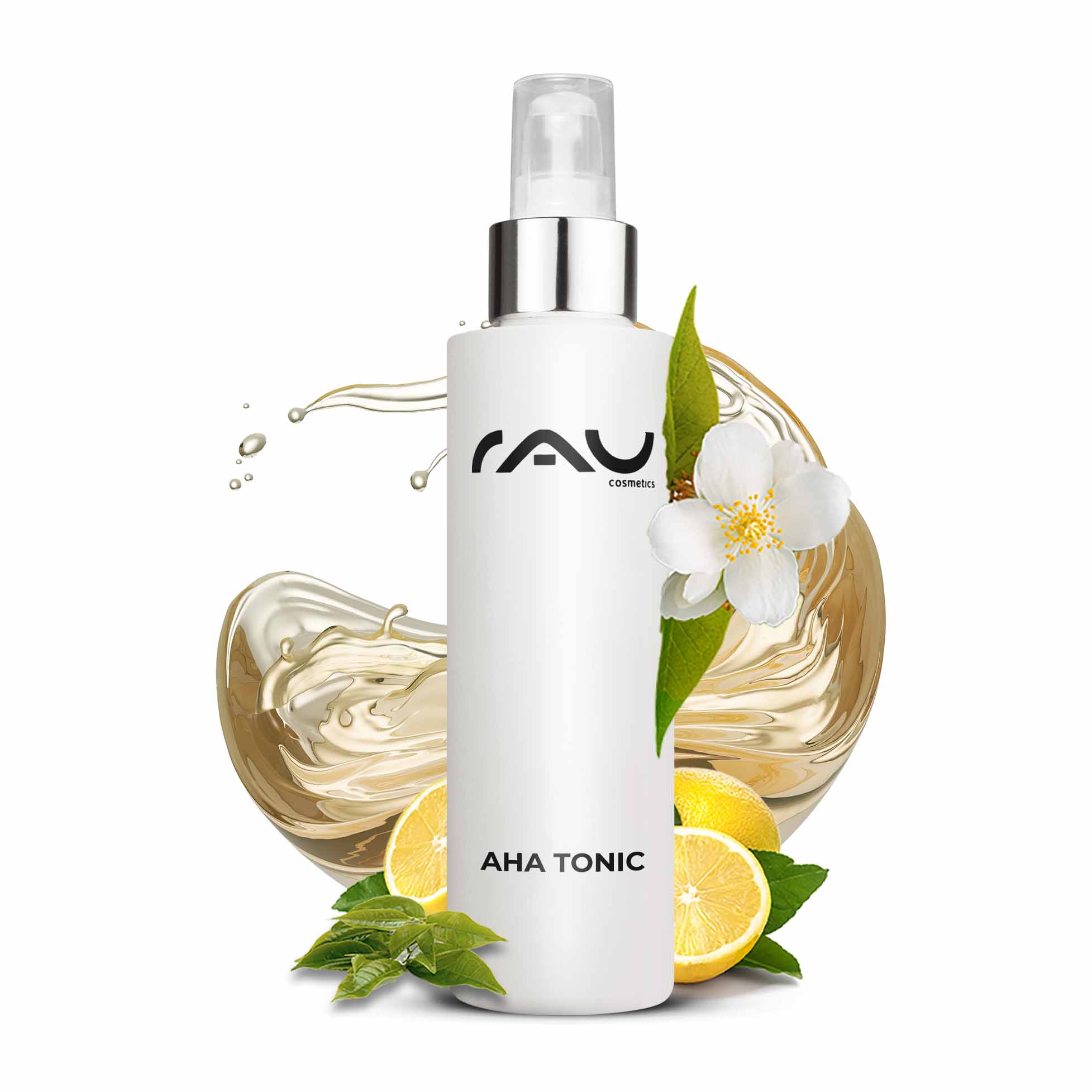
- AHA Tonic 200 ml — mild fruit acids as a toner. Helpful if you want to gently exfoliate and your complexion looks dull.
- Niacinamide Astaxanthin Serum Roll-On 10 ml — spot care with niacinamide and astaxanthin. Practical for on the go and easy to apply where needed.
- Silvercream 50 ml — with MicroSilver BG, for skin areas prone to blemishes or redness. Take a look at our active ingredient lexicon entry on silver too.
Not sure what suits your skin type? Take four minutes for our Skin Type Finder. You'll get a recommendation matched to your current concerns — no sales pressure.
Understanding preservation: 4 myths we like to bust
Several half-truths circulate around "paraben-free". Here are the four we encounter most often — and how we see them:
- Myth 1: "Paraben-free = natural cosmetics." Not true. Paraben-free simply means no parabens are in the product. A brand can be paraben-free and formulate synthetically — as we do at RAU, as active-ingredient cosmetics. More on this distinction in our article Vegan vs. Natural Cosmetics.
- Myth 2: "No preservatives is always better." Without preservation, a water-based cream would become contaminated within days. The question isn't "whether", but "with what".
- Myth 3: "Natural preservatives are always gentler." Plant-based preservatives can also trigger reactions or irritation — think essential oils. Mild doesn't automatically mean well-tolerated.
- Myth 4: "If the EU allows it, it's tested enough." EU cosmetics regulation is considered among the strictest worldwide — and substances are still regularly reassessed. Anyone proactively choosing alternatives is simply taking the precautionary step earlier.
If you're currently taking a more critical look at your ingredients overall, also check out our article Microplastics in Cosmetics. For us, both topics — parabens and microplastics — come down to the same question: what do we deliberately leave out, so your skin gets the best?
How to build a paraben-free routine — step by step
You don't have to switch everything tomorrow. A calm, lastingly skin-friendly routine forms in small steps:
- Step 1 — Take stock. Look at the INCI lists of your current products. Search for "…paraben". Mark the products you'd like to swap.
- Step 2 — Set priorities. Start with the products you use widely and daily — day cream, serum, cleanser. Spot treatments like roll-ons are less urgent.
- Step 3 — Choose a replacement. Don't just look at "paraben-free" — look at the whole formula: active ingredients near the top of the INCI list, sensible combinations, carrier ingredients that suit your skin type.
- Step 4 — Watch for reactions. Don't switch everything at once. That way, if a reaction occurs, you'll know which product was responsible.
- Step 5 — Be patient. Your skin often needs four to six weeks to adjust to a new routine. Visible changes take time — and results can vary individually.
If topics like adult acne or redness are relevant to you, our articles Blemish-Prone Skin After 40 and Caring for Couperose the Right Way are helpful next reads — both topics benefit strongly from choosing your preservatives consciously.
Frequently asked questions about parabens
Are parabens banned in cosmetics in the EU?
No, not all of them. Methyl- and ethylparaben remain approved in limited amounts. Propyl-, isopropyl-, butyl- and isobutylparaben are heavily restricted in children's cosmetics (under 3 years) and have had their overall concentration reduced.
How do I recognise parabens on an INCI list?
They almost always end in "…paraben": methylparaben, ethylparaben, propylparaben, butylparaben, isobutylparaben. The INCI list is usually on the back of the packaging or on the outer carton.
Does "paraben-free" automatically make cosmetics better?
No. What matters is the whole formula — which active ingredients are included, which preservatives are used instead, and whether the product suits your skin type.
Does paraben-free cosmetics last just as long?
Yes, if the preservative system is cleverly put together. All our products are tested for microbiological stability in certified German labs. You can see the shelf life after opening from the PAO symbol (e.g. "12M" for 12 months).
Can parabens trigger skin reactions?
Contact reactions to parabens are possible, but comparatively rare next to many fragrances or essential oils. With very sensitive skin, it can still make sense to switch to alternatives — especially in combination with other potentially irritating factors.
Are parabens and microplastics the same thing?
No. Parabens are preservatives, microplastics are solid or semi-solid plastic particles and polymers. Both are discussed critically, but for different reasons. Read more in our article on Microplastics in Cosmetics.
Our promise
We don't promise you anything we can't keep. We don't promise overnight miracles either. What we do promise: we formulate our skincare so that we'd give it to our own daughters, sisters and mothers with a clear conscience. For us, that includes leaving out parabens and reassessing our preservation system every year against the current state of science.
If you have questions about a specific product or an ingredient, feel free to reach out. Skincare that suits you starts with knowledge — not advertising promises.
Note: This article doesn't replace medical or dermatological advice. For persistent skin issues or known contact reactions to preservatives, we recommend seeing a dermatologist. Individual reactions to skincare products can vary — even with carefully formulated products.